Adventures of a Neti Pot Spartan

Meet Glen Hager.

Glen is, among other things, a US Navy Veteran, a skilled craft-beer aficionado, and a CrossFit junkie. He regularly wins or places highly in local Spartan Races. In short, he’s a manly man, and a good-looking one, at that. Glen has no need for the wimpy things in life, so when my husband Randy and I encountered Glen on one of our eight-mile beach walks, we were surprised to see him sniveling. Well, sort of sniveling. Sniffling is more like it.

“Allergies,” Glen said. “I’ve tried everything short of dynamite to open my nose. Nothing works.”

“Have you tried a neti pot?” I asked. I went on to explain where to purchase and how to use this awesome little piece of equipment that’s highly recommended by physicians and surgeons to clear, clean, and soothe the sinuses. “Be sure to boil the water to sterilize it, let it cool to a comfortable temperature, and add a packet of the saline powder that’ll come in your kit.”
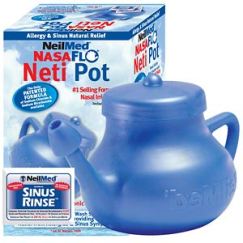
neti-pot

“Sounds like waterboarding,” Glen said, then puffed out his chest. “But I can take it.”

I convinced him that it’s an easy process, and while it may take a time or two to get the hang of it, he’d feel much better even after the first try.

If only!

That evening, Glen told us that when he went to pick up the neti pot I’d recommended, sitting just to the right of it was the Spartan version—a squeeze bottle with “a huge, black, nostril-filling power head.” Of course, that’s what he bought. He got it home, breezed through the instructions, and dumped out “a whole butt load of saline packs” that came in the box. The plastic neti bottle he’d purchased was stiff and firm, and it took a little effort to squeeze water out of it when he first rinsed it, so our strong-man friend knew he’d purchased the perfect macho product for his masculine needs. Remembering my admonishment about sterility, he boiled eight ounces of water in a measuring cup.

And that’s when things began to go south.

“If one packet of saline is good for you,” Glen later said, “two would do the job better and faster, right?” He dumped in two packets and poured the boiling water into his bottle and headed for the bathroom sink.

“I let the water cool for a few minutes, then I bent over the sink, inserted the big, black, power-nozzle into my nose, and gave a mighty power-squeeze. Well, the boiling water had softened the bottle just enough to allow me to generate about 150 PSI of water pressure, so I rapidly injected about four ounces of scalding water—with a saline density approximating that of the Dead Sea—into my skull.

“Hot water shot out of every orifice above my shoulders (and a few below). Snot, earwax, eye boogers, a tooth filling, that ball bearing I shoved up my nose when I was three, and the bug that crawled into my ear when I was six all came shooting out at once.”

“Oh, no, Glen!” I said, trying to contain my giggles, “What did you do?”

“Well, before I fully regained my senses, I quickly injected the other nostril.

“The good news is,” he said, “I have no more congestion! Afterward, I felt so darn good I went on a Harley ride to cool my scalded-and-salt-cured sinuses. Truly, I feel better than I have in weeks!

“I gotta say, though,” he said in a humbled voice, “do-it-yourself enemas are now off my “I Can Do This’ list.”

Yes, readers, I probably should have prefaced this truth-is-stranger-than-fiction story with a “Don’t Try This at Home” warning, but surely no one, save Glen Hager, will ever have quite this same experience.

“After all,” he said, “you should keep in mind that I’m the guy who has performed minor surgery on myself more than once with a Kabar.”

True . . . but that’s another story.
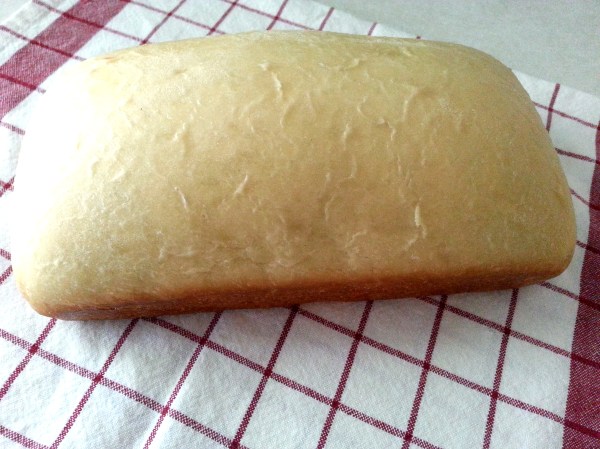


Sharing Homemade Bread

Today is bread day.

A few weeks ago, I succumbed to an urge that had been rising within me for a few months, and that was to make bread. Not just any bread, not bread from a boxed mix, and nothing that could be whipped up in a few minutes’ time, dumped into a bread machine, and popped out in a squarish loaf resembling an Amazon.com cardboard package. I wanted to make homemade sourdough bread; the kind that takes at least a week to prepare, the kind that must be fed and nurtured and allowed to rest, the kind created from—and by—living, breathing beings.

I should tell you that I killed my first starter.

There are certain, unbreakable, scientific laws that come with making homemade sourdough bread, and as ominous as that sounds, they’re actually quite simple to follow. That is, as long as you remember one of the most important rules, that being that you must stir your starter with a wooden spoon. Any contact with metal spoons (nickel, silver, aluminum, etc.) can introduce molecules that will kill the living microorganisms of yeasty sourdough starter. When feeding my sourdough starter the first time, you guessed it; I grabbed a metal spoon. Two days later, instead of the sweetly sour fragrance given off by healthy sourdough starter, mine reeked of rotting garbage, and the bubbles that occasionally rose to the surface had ceased. My starter had stopped breathing and died.

Bread mixing 1

I’ve taken more care since then, and today as I stirred sugar, salt, oil, and flour into my starter and began kneading the dough, I thought of stories and of writing. Why is it that one creative act feeds another? I may never know the answer, but I’m always grateful for the inspirational nourishment.

As I worked the dough, I recalled scripture from the King James Version of the Holy Bible: “And Jesus said unto them, I am the bread of life: he that cometh to me shall never hunger; and he that believeth on me shall never thirst” (John 6:35). I then thought of even older writings, one from the ancient Anglo-Saxon story of Beowulf, in which the bakers charge a share of grain to make and bake bread for the entire community in communal ovens. I was further inspired to look up a couple of quotes that I remembered from other poems and stories, wondering why these snippets have stuck with me for so long, choosing today to bubble to the surface:

“A Book of Verses underneath the Bough
A Jug of Wine, a Loaf of Bread–and Thou
Beside me singing in the Wilderness—
Oh, Wilderness were Paradise enow!” –The Rubaiyat of Omar Khayyam, 5th Ed.

And from more recent works:

“They swallowed the dark bread. It was like daylight under the fluorescent trays of light. They talked on into the early morning, the high, pale cast of light in the windows, and they did not think of leaving.” –Raymond Carver, from “A Small, Good Thing”

“The heat of the bread burned into my skin, but I clutched it tighter, clinging to life.” –Suzanne Collins, from The Hunger Games

You probably recall many other examples of bread used symbolically in literature. Why is it that writers often mention bread in their stories—aside from the obvious, that their characters must eat? Bread does more than simply feed the hungry protagonist; it serves as metaphor for deeper issues and hidden secrets in a story. Bread is sometimes used to represent life and health, or the lack thereof (as in stale bread, or moldy bread); it is used to represent plenty, as in the Biblical story of the loaves and fishes; it’s sometimes symbolic of comfort, family, and unity, as in To Kill a Mockingbird; and, in Hansel and Gretel, breadcrumbs are used to mark the way back home. It’s this last metaphor that I chose to use in my current novel-in-progress, tentatively titled Romie & Jasper’s Big Empty:

“I stand on the back deck of the house, overlooking the acres and acres of grapevines, and I feel small, as if I’ve shrunk. I wonder if it’s true, if I have become smaller each time I’ve moved, if I left behind a broken-off piece of myself, like a trail of breadcrumbs, so I can someday find my way back to whatever place might be home.”

As I kneaded my bread this morning, it occurred to me how much making homemade sourdough bread is akin to writing. We put in the basic ingredients—our nouns and verbs and punctuation—and we let them rest. Days later, we return to the mixture, feed it with fresh words, stir them around, and let them breathe. After more respite, we keep a carefully measured portion, toss out what isn’t needed, and we add something sweet, something salty, and we work out the lumps and bubbles, ensuring that when we are done, it will rise and nourish all who taste it.

My sourdough recipe makes three loaves: one for today, one for later in the week, and one to share with friends. Sharing homemade bread—and memories and stories—with friends is my favorite part of the artistic process: it is the giving of one’s creativity, of one’s effort, of oneself, however noble or humble that gift may be.

“And he took bread, and gave thanks, and brake it, and gave unto them, saying, This is my body which is given for you: this do in remembrance of me.” Luke 22:19 (KJV)

WWRD? – What Would Rhonda Do?

enjoli1

From the time I was a pre-teen, I wanted to be an Enjoli woman; you know, bringing home the bacon and all that goes with it. I love bacon! (Ooops! Sorry. Got a little excited there.) Even now, I have a ridiculous number of personal goals—so many I’d have to live to beyond Methuselah’s age to reach them all. Because of this, I have many role models whom I call my everyday heroes; women whom I admire for the way they do this thing or that thing, who have accomplished goals at which I hope to succeed, who grab life by the horns each day, shouting, “Ride ’em, cowgirl!” I won’t attempt to model myself after Oprah, Martha Stewart, Suze Orman, or Bethenny Frankel, because the thought of having to do all that they do (with the aid of a team of assistants, of course) terrifies me. Instead, women whom I personally know are the sources of my inspiration, because if they can achieve success, there’s hope for me.

I’ll admit that I stretch myself thin. I am a wife and a mother. I work as an editor and ghostwriter. I am an adjunct English professor and a Realtor. I write for this blog and occasionally for two others. I review books, and I am currently writing two novels and revising a short story collection of my own. Rarely does a day pass when I don’t think of at least one of the talented, inspiring, women in my life, and in some small way, I try to imitate the thing they do or have done so well. They are, each one of them, an inspiration to me, and when I’m faced with a challenge, I ask myself, “What would she do?”

Christians sometimes utilize the catch phrase, “What would Jesus do?”, and while it’s admirable to apply that kind of wisdom to the big decisions in your life, I find it difficult aspire to those heights, especially when dealing with life’s minutia. Jesus is a godhead, after all, and since I’m just a regular ol’ human being, I won’t begin to pretend that I can achieve the miracle of feeding thousands with a loaf of Wonder Bread and a can of tuna, when I do well not to burn the casserole. No, I’ll stick with imitating feet-on-the-ground women I admire, whom I can lock into a bear hug of thanks when I successfully mirror one of their achievements.

For example, when I’m faced with a classroom full of bored English comp students, I think, What would Rachel Bragg do? Rachel made literature so incredibly interesting for me that it became my concentration of study. She even coaxed me to study a course on fantasy literature, a subject I thought I hated until I took her excellent course. By mirroring her entertaining, yet no-nonsense approach to engaging and motivating students, my first semester of teaching college was a success.

When I think I can’t find the time to face yet another blank page in one of my works in progress, I ask, “What would Leslie Pietrzyk do?” Leslie teaches in two graduate writing programs, is active in two writing groups, is the editor of a literary magazine, authors a wonderful blog I follow, publishes new essays and short stories seemingly every other week, has authored two novels and is soon to release a third. If she can make time to write with all that’s on her literary plate, so can I.

When friends pop by unexpectedly for an evening (or even a long weekend), I ask myself, “What would Momma do?” I’ve watched my mother joyfully entertain and prepare a spread for a dozen unexpected guests more times than I can count. And, while tiptoeing along the poverty line most of her life, my mother still donates an extraordinary amount of time and energy to charity functions, from hand-stitching quilts for international missionaries, to heading up “The Master’s Basket”, a women’s group that makes and delivers food to sick individuals and bereaved families weekly. She frequently volunteers in her church and community for dozens of different projects as needed. She’ll forever inspire me to give selflessly and generously.

When my writing gets too dark and serious, or my prose falls flat, I think, What would Karin Gillespie do? Karin’s novels, essays, articles, and blog posts never fail to make me laugh, and she finds humor—and writes it so well!—in all of life’s foils and foibles. If you’ve ever chuckled when reading one of my blog posts, it’s because I’ve learned from Karin’s fine example.

So many strong and smart women have inspired and continue to inspire me: my late mom-in-law Georgia White, who was an excellent to-the-penny home-finances manager; many mother/wife/professor/writer friends including Cheryl Russell, Gabrielle Brant Freeman, Kathleen Nalley Moore, and Pam Andrews Hanson (who also writes as Jennifer Drew); my uber-organized editing boss Sandy Tritt; my go-getter real estate broker Enis Qosja and brokerage owner Crystal Anderson . . . I could easily continue naming names and singing praises. You can bet there’s also something about you that I probably admire, prompting me to ask, “What would [insert your name here] do?”

Admittedly, it’s easy for me to get in over my head when I think this way. I often bite off more cud than a four-stomached cow can digest, and I occasionally feel bad when I fall short of the successes my role models have accomplished. Nonetheless, I realize that, while each of these women are phenomenal at one or three things I greatly admire, they may intermittently fail at something I do well. None of us is perfect, yet each of us strives to be successful at whatever it is that we do.

Acknowledging this fact leaves me with one important, pressing question: What would Rhonda do?

I know the answer to this one by heart: she would try very hard.

Extremely hard.

And sometimes she fails, but she cleans up the mess (even if it means sweeping it under the rug until her guests leave), and tomorrow she will try again.

The Enjoli woman should be so fortunate.

Touchdown Wings

“Left wing, chicken wing, it don’t make no difference to me.” 

–Singer-songwriter Woody Guthrie

I promised you recipes. No, I haven’t forgotten, because a friend—one who can take persistence all the way to peskiness—reminded me again that I promised you recipes. So, in honor of the Big Game That Cannot Be Named on Social Media, here is one of my prize-winning recipes for the perfect tailgate food—even if you’re tailgating in your own living room.

Rhonda’s Touchdown Wings

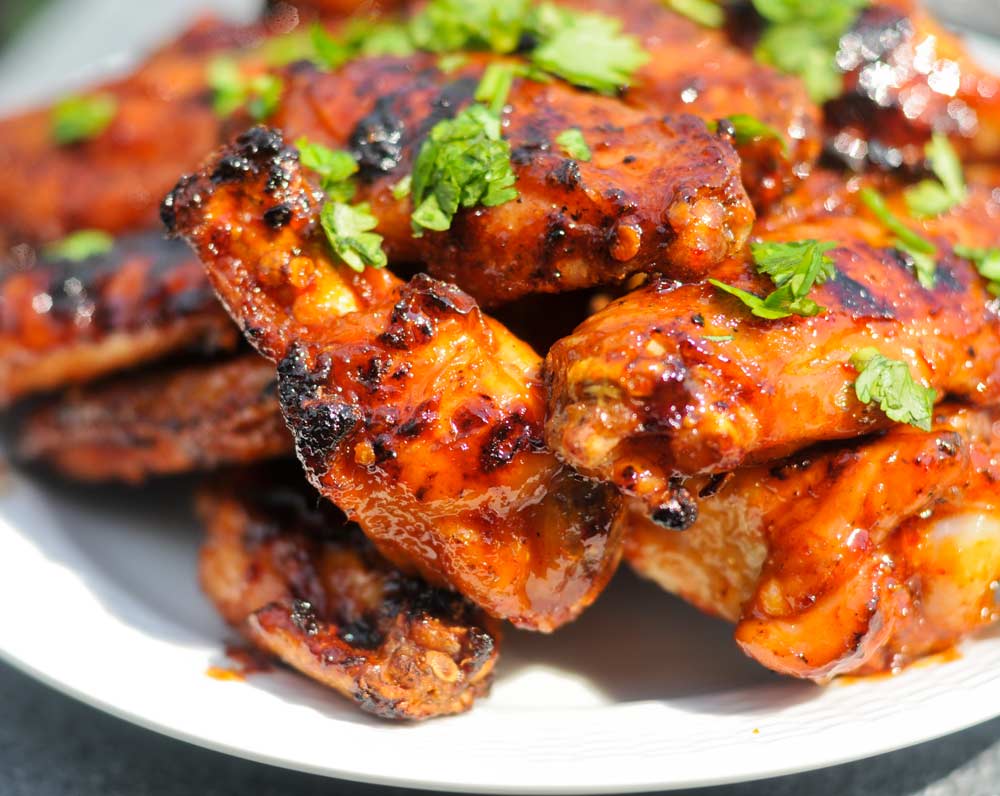
touchdown wings

 ¼ cup maple syrup

1 large bottle teriyaki sauce

1 tsp chopped garlic

½  cup Tabasco sauce

½ to 1 tsp red pepper flakes (optional)

4-5 pounds chicken wing drumettes

Mix the first four ingredients, stirring well until the maple syrup has dissolved. If more heat is desired (I like mine combustible), add the red pepper flakes. (If you prefer very mild, teriyaki-flavored wings–we’ll call these Field Goal Wings–you may omit the Tabasco sauce, as well.) Now, I have to insist here that you use Tabasco sauce, in lieu of any other brand. Don’t make the mistake of using wing sauce, which, when diluted with teriyaki and maple syrup, will cause your wings to turn out bland, producing Five Yard Penalty WingsYou don’t want that.

Place the chicken in a large, lidded container. Pour the sauce mixture over the wings, and stir well. Cover the wings (shake them if the lid fits tightly). Marinate the wings in the sauce 6-8 hours or overnight. Don’t cheat and cook them after four hours or so. You want the seasoning to permeate the skin and leave you with moist, juicy Touchdown Wings, not Artificial Turf Wings.

For the very best flavor, arrange wings in a single layer on a hibachi, charcoal, or gas grill, and grill five minutes, then turn and grill another 3-5 minutes, until wings are done. If you want to prepare in your air fryer, arrange in a single layer at 375 degrees. Check after 4 minutes, turning or shaking your pan. Return to the air fryer for another three minutes. Monitor thereafter each minute until wings appear crisp and moist on the outside. I highly recommend checking one wing (the largest) for center doneness. NOTE: Air fryers differ greatly, as do their cooking times, so adjust the time for your model.

As another option, you can bake these babies in the oven. Simply line a cookie sheet with foil, and arrange wings in a single layer. Drizzle a scant amount of the marinade over the wings (not much, you only want to keep them moist, not drown them). Bake at 350 degrees for one hour, turning each wing over after 35-40 minutes.

Warning: If you make these wings for friends, know that you’ll have to make them every time there’s a football game, cookout, or picnic. There’s a reason I won a cook-off prize with these yummy little chicklets ($500, y’all!) and one bite will tell you why.

Please Be Nice

“Be nice to each other. You can make a whole day a different day for everybody.” –Richard Dawson


I wonder why it is that so many people find it difficult to be nice. I’m not talking about the Southern gentility of gentlemen opening car doors for ladies, or the young taking the arm of the elderly to assist in crossing the street. Nor am I talking about putting away your cell phone at the table to engage in polite conversation with the person sitting across from you—though these things are indeed nice.

I’m talking about niceness, as in the opposite of rudeness. I’m talking about keeping a civil tone of voice instead of screaming at someone. I’m talking about taking a breath and removing the venom from your voice before answering a simple question.

We all have bad days—I get that. Alarm clock didn’t go off, kid missed the bus, tire was flat, every traffic light turned red, coffee dripped on your suit . . . Murphy’s Laws are ugly laws. The person sitting across from you, however, or the person on the other end of the phone, didn’t cause any of those issues, and they don’t deserve the brunt of your anger. Tomorrow—or even a few hours from now—these things won’t matter. You’ll be on to the next predicament, and then the next, and the next one. What makes each of these challenges easier is to understand that, no matter how bad the moment seems, it will pass, and it’s true that somewhere, someone else is dealing with something much worse than a coffee stain on a new blouse.

But enough with the bromides—except this one: life is tough. Tough for you, tough for me, tough for everyone, but that doesn’t give any of us the right to be mean.

Maybe has to do with my Appalachian upbringing, because where I’m from, we believe it’s our compulsory duty to help our neighbors—even if we don’t particularly like them or agree with their politics, religious choices, or lifestyle. Or maybe it’s because I was raised in a family where I’ve watched my father give the money he needed for his heart medication to a family who lost their home in a fire; or perhaps it’s because I lived most of my life in the South, where hospitality is the norm, and even the meanest comment is often prefaced with “Bless his heart.” Any of these experiences might explain why I’m always stunned, and sometimes even hurt, by rude behavior and meanness.

Recently I completed a simple real estate transaction, and during the very routine process of completing paperwork and legwork, I was screamed at (I’m talking about true, hold-the-phone-away-from-your-ear-to-preserve-your-eardrum screaming) by another Realtor who was angry about something over which I had no control; I was lied to multiple times by a contractor; and I saw a customer reduced to tears because a snappish title-company executive didn’t trust its own title agent (also a notary) to verify a faxed signature he witnessed and notarized. Each one of these upsetting incidents could have been rectified, or at least made easier to accept, with one thing: niceness, a.k.a. honesty and human compassion.

Look, I’m not asking you, or anyone, to jump on the free love, shirt-off-your-back, bow-down-and-kowtow bandwagon. I am, however, asking you to be nice. I’m reminding myself to be nice. NICENESS IS NOT WEAKNESS. Don’t ever mistake it as such. We all know someone in a position of leadership or power whom we can describe as “the nicest person you’ll ever meet”, and we’d never call them weak. Remember that even bad news is better received when it’s delivered respectfully, with kindness and compassion: knowing this puts you in a position of strength and power.

Do you remember the heartwarming, B-rate movie Roadhouse starring the late Patrick Swayze? If so, you’ll recall his lecture to the bar bouncers—the guys who have the job of throwing out knife-wielding, gun-toting drug-smugglers and riffraff—in which Swayze’s character repeats time and again, “Be nice.”

Really, folks, it’s that simple.

You’re going to encounter incidents out of your control today; be nice. You’re going to encounter someone who is arrogant and self-inflated; be nice. You’re going to talk to someone who may be experiencing physical pain, the recent loss of a loved one, a cheating spouse, or financial or emotional bankruptcy; be nice.

If we’re truly lucky, our niceness will be contagious.

be nice

Order from etsy.com here: Be Nice Sign

Blog at WordPress.com.

Up ↑

www.rhondarandall.com

Author of deliciously decadent stories.

Discover WordPress

A daily selection of the best content published on WordPress, collected for you by humans who love to read.

Suzanne Heagy

Small lives, awkward moments, immense relief.

My Blog

This WordPress.com site is the bee's knees

The View from Goose Hill

A Second Look at What I Thought I Knew about Life

The Skinny Poetry Nation

For those who love, are learning, and have mastered the Skinny Poetry Form

The Backwords Writer

Writer Rosa Sophia

Storyshucker

A blog full of humorous and poignant observations.

Lucy Mitchell Author

Romance Author

Hawaii Pacific Review

Literary Journal of Hawaii Pacific University

Sliver of Stone Magazine

2010-2018 ARCHIVES

#amnoveling

Cathy Day's course on novel-writing at Ball State University

10,000 Tons of Black Ink

Featuring quality literary or experimental fiction and creative non-fiction.